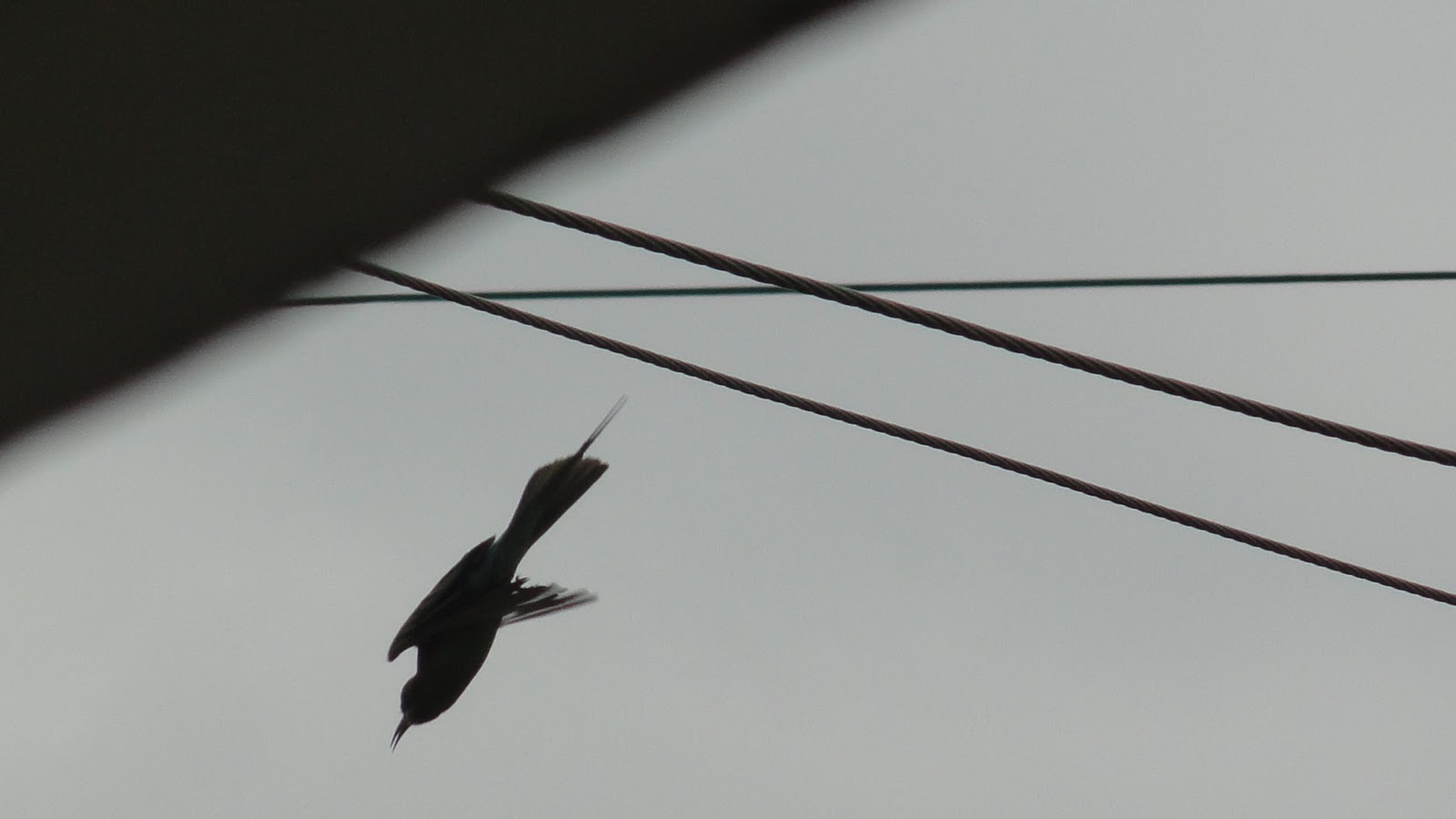
Throughout summer I've had the pleasure of watching the several bee-eaters who stopped on the electrical wires near our house and indulged in their favourite pastime. In this case it was picnicking on the myriads of dragonflies hovering above the marshy plot of land.

Although their plumage was more of bluish-green, I have never been able to capture that resplendence. They mostly arrived in the afternoon when the sun was facing the camera. Any attempt to take the photos with my back to the sun would have resulted in their flight to safer wires!;)

 Most species of bee eaters are found in Asia and Africa but others occur in southern Europe, Australia, and New Guinea. All bee eaters have down-turned bills and pointed wings which give them a swallow-like appearance when seen from a distance. There are 26 different species of bee-eaters. These birds pursue any type of flying insects but honey bees predominate in their diet. Before eating its meal, a bee-eater removes the sting by repeatedly hitting and rubbing the insect on a hard surface. During this process, pressure is applied to the insect thereby extracting most of the venom. Notably, the birds only catch prey that are on the wing and ignore flying insects once they land. Source.
 It was only recently that I noticed they no longer made their daily visits. I guess I'll have to wait for next summer to watch them swoop, dive, and fly. The flash of the bluish-green colours will be a joy to see again.

Although their plumage was more of bluish-green, I have never been able to capture that resplendence. They mostly arrived in the afternoon when the sun was facing the camera. Any attempt to take the photos with my back to the sun would have resulted in their flight to safer wires!;)